
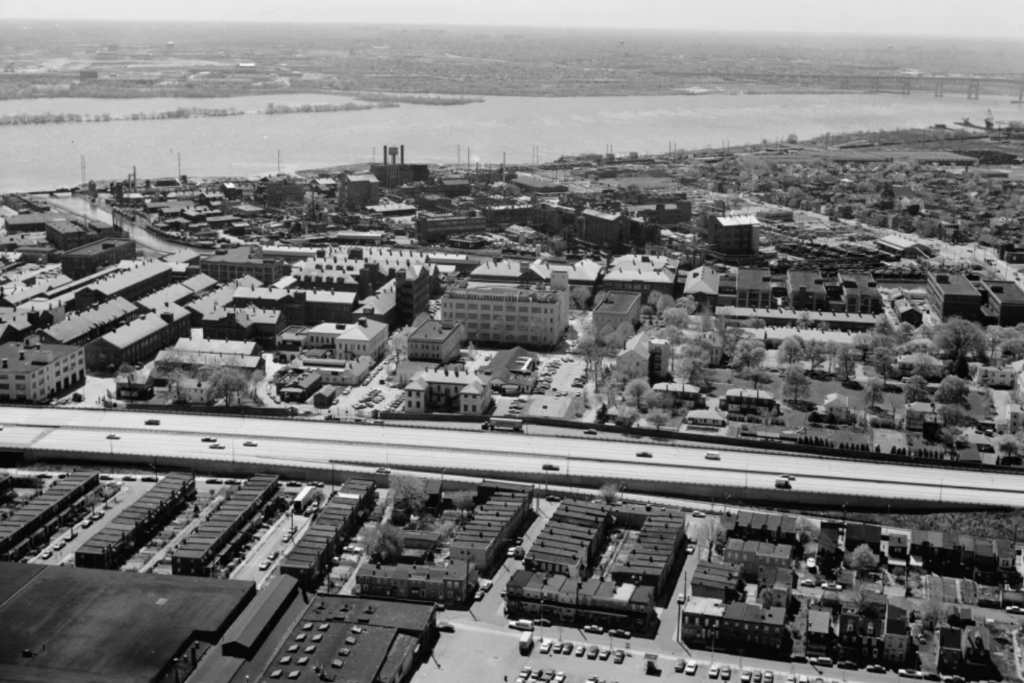
The Philadelphia-based Army ammunition plant closed in the 1970s. It currently is the site of a high school, food supplier and other businesses.
Story by Matt Lavietes, Reporter, NBC News
Three longtime Philadelphia police officers developed the same rare cancer, and the similarities in their cases were hard to ignore. They all had spent years working in the department’s narcotics unit. They all died of glioblastoma, an aggressive form of brain cancer, within years of each other. And they may not be the only ones.
Emily Lauck, 29, was never a police officer but a student whose school stood on the same property as the site of the Philadelphia Police Department’s Narcotics Unit.
Lauck was diagnosed with glioblastoma in January 2025, roughly a decade after graduating from high school and several years after the first of the police officers was diagnosed, her mother said. Within the last year and a half, she has lost her hearing, her ability to speak, her ability to walk and most of her vision, according to her mother.
“I’m literally watching my daughter die slowly every day,” her mother, Jennifer O’Brien, said. “I would never wish that on my worst enemy, but I wish that they could walk a day in her shoes. It’s just so unfair. Her entire life was ripped away from her.”
Many decades ago, Lauck’s school and the former police building used to house Frankford Arsenal, a sprawling ammunition plant in Northeast Philadelphia that operated from 1816 to the1970s. Today the property also houses food supplier Honor Foods, a veterinary practice and other businesses.
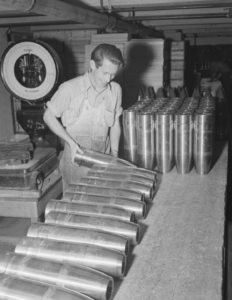
A man weighs shells during an inspection at Frankford Arsenal in the 1940’s. Photo courtesy of the Library of Congress.
The widows and estates of the three police officers have filed lawsuits against the city of Philadelphia and the past and current owners of Frankford Arsenal, alleging they failed to protect the officers or warn about the dangerous substances at the site. The glioblastoma
lawsuits and Lauck’s illness have raised questions about the safety of a property that houses the two schools, food supplier Honor Foods, a veterinarian and other businesses.
HSP Arsenal, which owns the buildings, said it purchased them in 2017 after the police department’s tenancy at the site ended. According to the company, environmental reviews and testing before the purchase found the buildings safe for occupancy under state and federal laws.
Following the lawsuit, HSP said it commissioned additional testing of individual spaces by an environmental consulting firm. According to the company, those tests did not identify conditions that made the buildings unsafe for tenants. HSP said it has shared the results with tenants, including Maritime Academy Charter School, and plans to conduct another round of testing in early fall and annually thereafter.
“We recognize the importance of tenant concerns on these issues,” HSP said in a statement to NBC News.
The Philadelphia Authority for Industrial Development, which operated the site from 1983 to 2014, declined to comment. The City of Philadelphia declined to comment, citing the pending litigation. Franklin Towne Charter High School, Maritime Academy Charter School and Honor Foods also did not respond to requests for comment.
‘Risk identified’
In the 1970s, the Army transferred ownership of the Frankford Arsenal to the city of Philadelphia. In the ensuing decades, the property has been in the hands of private owners and developers.
The U.S. Army Corps of Engineers (USACE) has investigated contamination at the site for decades, documenting hazardous substances including lead, depleted uranium and industrial chemicals found to be dangerous to human health. The agency oversaw the removal of contaminated soil and other hazardous materials in portions of the site while continuing to investigate contamination in other areas, according to a 2015 report.
The USACE report found that there was “unacceptable risk identified for potential future residents at the site, and six Areas of Concern were identified as requiring additional actions to address risks to potential future residents.” One of those areas of concern was where the former narcotics unit was housed,
according to the report.
“It was very normal for cops to work overtime, 10, 15, 20 hours at a time,” Bill Davis, an attorney representing the wives of the officers, said. “What’s the difference between living there and working there when you’re spending that amount of time out of place?”
The site was excavated for hazardous materials in the years that followed, according to subsequent USACE reports. It is currently “safe for its current mix of industrial, commercial,institutional, and residential uses,” according to more recent USACE records.
The USACE declined to comment.
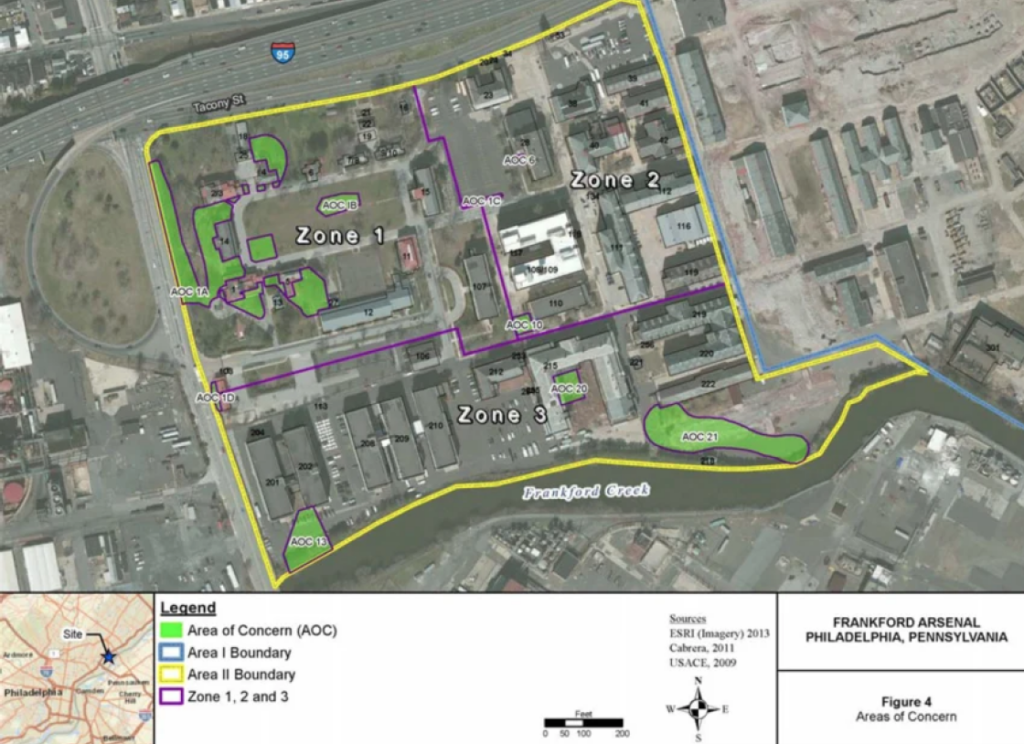
A map of the former Frankford Arsenal, showing six areas of “unacceptable risk” to human health. The area of concern in the bottom right is adjacent to the Philadelphia Police Department’s former narcotics unit, Building 202. Photo courtesy of the U.S Army Corps of Engineers.
The widows and the estates of the three deceased officers have filed separate lawsuits against the city of Philadelphia, the past owners and current owners of Frankford Arsenal, alleging hazardous materials on the property caused the officers’ glioblastoma.
Between 1994 and 2015, the three officers worked in the narcotics unit for at least eight years,according to lawsuits. They were diagnosed with glioblastoma between 2018 and 2024 and diedbetween 2019 and June 2026, according to the suits.
Glioblastoma is a rare and aggressive form of brain cancer, with an annual incidence rate of about 3.2 cases per 100,000 people, according to the Centers for Disease Control and Prevention. There are no known causes for glioblastoma, according to the CDC. However, risk factors include inherited genetic syndromes and exposure to therapeutic ionizing radiation,including X-rays.
Dr. Stephen Bagley, who is the clinical director of the Penn Brain Tumor Center and an associate professor at the University of Pennsylvania School of Medicine, said exposure to radiation typically occurs 10 to 30 years prior to the onset of glioblastoma. However, he said “there is no way to prove” that clusters are linked to environmental exposure.
“If you have three people, like in this one, certainly it’s strange, but coincidences happen all the time,” Bagley said. “There’s enough randomness in the world that sometimes things look like areal meaningful trend when they’re just a statistical anomaly.”
The plaintiffs claim that the defendants knew carcinogens were present at the property, failed to warn the officers and concealed the potential danger. They are seeking damages for medical expenses, pain and suffering, physical impairment, disfigurement, loss of quality of life and death, among other claims.
‘Robbed of our happy retirement’
After Michael Deal retired from the department in 2014, he and his wife, Donna, moved to Las Vegas to be closer to their two adult sons. The couple had met on a blind date in 1981. Donna Deal said her husband loved retirement life and joined several sports leagues.
“He was doing all the things that he ever wanted to do,” she said. “He was a huge, huge sports fan, and I swear, one arm bled red for the Phillies and one arm bled green for the Eagles.”
In May 2018, that happy retirement abruptly changed.
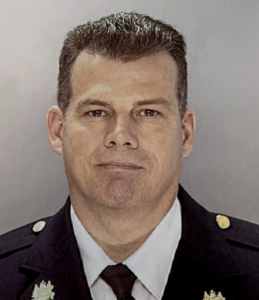
Michael Deal. Photo courtesy of the Deal family.
Michael Deal came home from a routine walk in their desert neighborhood feeling dizzy, Donna Deal said. At the hospital, doctors found a tumor that was “already the size of a golf ball,” and, according to Donna Deal and the lawsuit, he was diagnosed with glioblastoma. Donna Deal said his family had no history of cancer.
“Mike was very healthy,” she said. “We didn’t have any old people diseases.”
In the ensuing months, her husband started losing some control of his body and experiencing unusual mood swings, she said. Deal said that her husband became uncharacteristically affectionate and, at times, “would cry for no reason at all.”
“Mike was a cop — a tough guy. He was always affectionate, but this was like overkill to all of us,”she said. “I mean, it was lovely, but it was overkill. It wasn’t the Mike we knew. … Emotionally, he was all over the place.”
He died in January 2019, just eight months after his diagnosis. He was 64 years old.
About five years later, Donna Deal said, she was contacted by another police officer who told her that other officers who had worked at the narcotics unit were being diagnosed with glioblastoma.
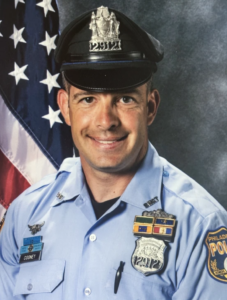
Joseph Cooney. Photo courtesy Bernadette Cooney.
One of them was Joe Cooney.
In March 2024, Cooney collapsed on his way to a ceremony at the police academy. When doctors performed a CT scan, they found a tumor that had grown so large that it had begun bleeding, according to his wife, Bernadette Cooney. Further testing indicated that he had glioblastoma, according to the lawsuit, filed by Cooney and his wife in December. His family had no prior history of the rare cancer, Bernadette Cooney said.
“Joe took it like ‘it’s fine, everything’s gonna be OK,’” his wife, Bernadette Cooney, said. “I remember I burst into tears, and he looked at me and winked and said, ‘It’s gonna be OK.’ He said, ‘I’m going to be fine.’”
Bernadette Cooney said her husband underwent three brain surgeries, chemotherapy and a clinical trial at the University of Pennsylvania. Even as he began losing his ability to walk and see, she said, he remained determined to fight the cancer, enrolling in physical therapy.
Joseph Cooney with his wife, Bernadette Cooney. Photo courtesy of Bernadette Cooney.
Joe Cooney died in June at age 54, leaving behind six children ranging in age from 6 to 23. His youngest child has autism, according to his wife.
“It is a big, big loss,” she said.
Donna Deal said she was incensed when she learned that other people from her husband’s former unit also developed glioblastoma.
“I feel like we were both robbed of our happy retirement together,” she said. “It wasn’t supposed to end this way.”
Michael Deal lost more than a happy retirement, his wife said. He never got to meet his two granddaughters or attend his younger son’s wedding. Although she remains very close with her sons, she said the family isn’t the same.
Michael Deal with his wife, Donna Deal, and their two sons. Photo courtesy of Donna Deal.
“Sometimes I just feel like I’m not enough, like they need their father. They’re boys,” she said.“It’s just left a big hole, and I try to carry all the weight myself. We should have grown old together, and that’s just not going to happen.”
A third officer, Andrew Schafer, worked in the department’s narcotics unit at Frankford Arsenal from 2002 to 2015, according to one of the lawsuits. He was diagnosed with glioblastoma in August 2023 and died in March this year.
‘Piece by piece’
Before she got sick, Lauck was living on her own in Levittown, Bucks County, and worked as an accountant.
“She was very carefree,” said her mother, O’Brien. “She was my adventurer. She’s the middle of my three oldest children, the girl in the middle of two boys.”
Over Christmas in December 2024, Lauck and her family thought she had a severe ear infection.
“She was getting dizzy, and she was driving into the other lane,” O’Brien said. “And when she would walk, she kind of looked drunk.”
When her ear didn’t get better a few weeks later, she checked herself into an emergency room, where doctors told her she had a brain tumor. Several days later, following surgery, the 29-year-old learned she had glioblastoma.
Bagley said of the hundreds of patients he treats at a given time, four to five are in their 20s.
Emily Lauck and her mother, Jennifer O’Brien, before getting sick. Photo courtesy of
Emily Lauck.
Lauck underwent radiation and started immunotherapy drugs, which caused her to gain nearly 70 pounds, according to O’Brien. She has since lost her mobility, became deaf about a month and a half ago and recently underwent surgery for an infection in her right eye, her mom said. She now communicates with her mother primarily by text.
“At least I got to talk to her before,” a visibly emotional O’Brien said. “I’m literally watching, piece by piece by piece just slip away.”
A few months ago, a friend connected O’Brien with Joe Cooney while he was still alive. O’Brien said she has no proof that her daughter’s cancer was caused by anything at the arsenal, but she believes the shared location deserves investigation.
From 2009 to 2015, Lauck attended school at the former arsenal, first at Maritime Academy Charter School and then at Franklin Towne Charter School. Her years there overlapped with part of the period during which the officers worked in the narcotics unit.
“What are the chances?” O’Brien said. “When I looked into the other officers, they were all there around the same time that she was there, and like the prognosis, like the diagnosis of it, the month, the time between being there and it coming out, it’s like around the same years too. It’s weird.”
O’Brien said she has not contacted the school or sought legal counsel because her daughter’s daily health needs have taken priority.

Emily Lauck and her mother, Jennifer O’Brien, after getting sick. Photo courtesy of Jennifer O’Brien.
Before she became sick, Lauck wanted to marry, have children and return to school to become a psychiatrist and “help people,” O’Brien said.
“She didn’t get to have a career. She didn’t get to have a wedding. She didn’t get to have a marriage. She didn’t get to have babies. She didn’t get to do any of it. She was 28 years old,” she said. “Now she can’t even get up and go to the bathroom herself.”
There have been some bright spots.
“We joke around because before she was completely unapologetic,” O’Brien said. “And with family stuff, if she didn’t want to do something, she was kind of like, ‘F— off, I’m not coming,’ or, like, no apologies, right? But now she seems nicer. I don’t know. It’s weird.”
Lauck, who now uses a wheelchair, regularly goes out with her boyfriend. The pair met before her diagnosis.
“She loves concerts. She can’t even freaking hear at this point, and she still goes to concerts,”O’Brien said.
O’Brien said she quit her job to care for her daughter. She has also gone through a divorce. She has connected with others whose relatives have glioblastoma, but said even those conversations can be difficult.
“When they talk about, ‘Oh my mom passed away after four months,’ or ‘My mom or my sister or whoever passed away, and it was such a short battle.’ It sounds sick, but I f—ing envy them because this is hell on earth,” she said. “And it’s like I shouldn’t have to wish for my daughter to find comfort in death. I should never have to wish that as a mom.”
‘We show up’
Neither widow said the Philadelphia Police Department had contacted her in any official capacity about their husbands’ deaths or potential contamination at the narcotics unit.
The Philadelphia Police Department referred NBC News to a city representative when asked whether it has notified former officers who worked in the narcotics unit of potential health risks.The city of Philadelphia declined to comment, citing the pending litigation.
Bernadette Cooney, who is also a police officer, said she does not think the department intentionally failed the officers. But she said the city should do more to determine whether officers were exposed to hazards and to ensure they are assigned to safe workplaces.
“When the city needs the Philadelphia Police Department, we always show up,” Bernadette
Cooney said. “And I think that they need to show up for officers the same way we show up for them.”